
Checklist for Building a Supplier Diversity Program
A supplier diversity program integrates businesses owned by underrepresented groups into procurement processes, driving benefits like innovation, cost savings, and supply chain resilience. However, many companies struggle to implement these programs effectively. Here's a quick guide to building a successful supplier diversity program:
- Assess Your Current Process: Identify certified diverse suppliers and analyze spending patterns to uncover gaps.
- Secure Leadership Support: Gain executive buy-in and assign a program manager to lead efforts.
- Set Clear Goals: Define measurable diversity targets and create a written policy.
- Find and Engage Suppliers: Build a database using certification organizations and develop outreach strategies.
- Train Teams and Support Suppliers: Educate your team on diversity practices and provide resources to help suppliers succeed.
- Track and Improve: Use metrics to measure progress and refine your program regularly.
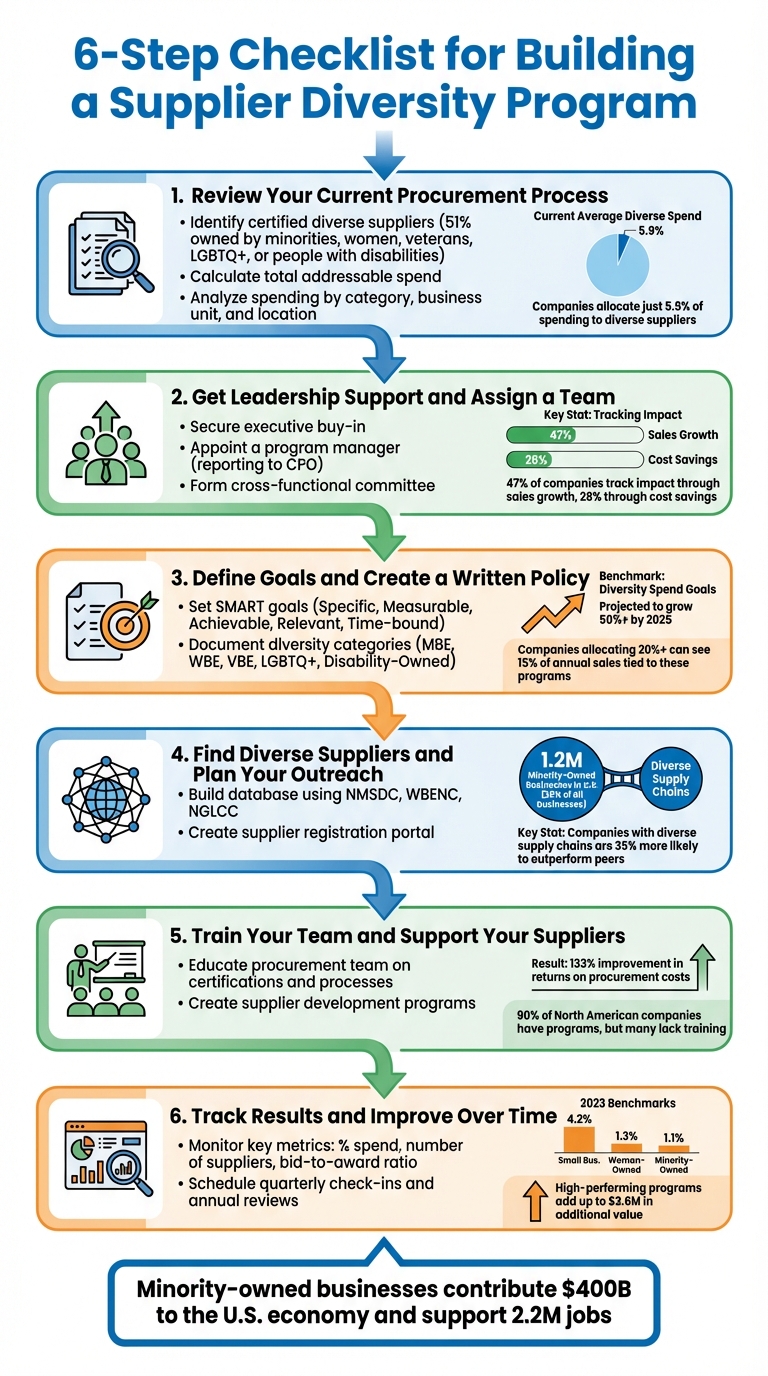
6-Step Checklist for Building a Supplier Diversity Program
Supplier Diversity Program Overview
sbb-itb-c68f633
Step 1: Review Your Current Procurement Process
Start by taking a close look at your current supplier diversity program to identify what’s working and where there’s room for improvement. Begin by pinpointing which of your suppliers are certified as diverse - meaning they’re at least 51% owned, operated, and controlled by minorities, women, veterans, LGBTQ+ individuals, or people with disabilities. This foundational step sets the stage for a deeper dive into your procurement practices.
"A successful Supplier Diversity program has a single source of truth that gives you all the answers... the how many, how much, and the accuracy." - SpendHQ
On average, companies allocate just 5.9% of their spending to diverse suppliers. To ensure your data is accurate, consolidate information from all your ERP and procurement systems into a single source. Doing this eliminates duplicates and minimizes errors. Next, calculate your total addressable spend by removing non-discretionary expenses - like taxes, utilities, and government fees - from your overall procurement budget. This calculation reveals the portion of spending you truly control and can potentially redirect to diverse suppliers. This foundational review is a critical first step in building a measurable supplier diversity program.
Analyze Your Spending Patterns
Once you’ve reviewed your procurement data, dig deeper to understand your spending patterns and uncover diversity gaps. Break your spending down by procurement category (e.g., IT hardware and software licenses, consulting services), business unit, and geographic location. This segmentation helps identify areas where diverse supplier participation is low.
For example, the Healthcare Anchor Network standardized total addressable spend definitions to double their spending with diverse suppliers.
Check that your current diverse suppliers still hold valid third-party certifications from organizations like WBENC or NMSDC. Then, look ahead at the next 6–12 months of contract renewals and upcoming bids to identify immediate opportunities to engage diverse vendors. A detailed spend analysis not only highlights current gaps but also guides future outreach and engagement strategies with diverse suppliers. Once your spending patterns are clear, it’s time to define your diversity categories.
Set Your Diversity Categories
Identify and prioritize the diversity categories that align with your business goals. Common categories include Minority-Owned (MBE), Women-Owned (WBE), Veteran-Owned (VBE), LGBTQ+-Owned, Disability-Owned, and Small Business. While it’s ideal to include all major categories, starting with one or two can help you build momentum.
For consistent reporting, rely on third-party verifications from organizations like WBENC or NMSDC. Note that Small Business may be included for compliance purposes, even if it doesn’t meet the 51% ownership threshold.
Your selected categories should reflect both your business strategy and any regulatory requirements. For example, organizations that receive federal funding often have mandates to include specific groups. Companies that allocate 20% or more of their spend to diverse suppliers can see as much as 15% of their annual sales tied to these programs. This makes choosing the right categories not just a regulatory necessity but also a smart business decision.
Step 2: Get Leadership Support and Assign a Team
After reviewing your procurement processes, the next step is to secure support from leadership. This backing is essential to ensure your supplier diversity program gets the resources, visibility, and momentum it needs to succeed. Executive buy-in is key - leaders can help connect the program to broader corporate goals like social responsibility or customer loyalty, while also ensuring it aligns with measurable business outcomes like innovation, market share, and financial performance. For example, 47% of companies track supplier diversity impact through sales growth, while 28% focus on cost savings. Using metrics like these can help tie the program directly to the company’s bottom line.
"Executive buy-in is crucial to allocate resources and prioritize supplier diversity initiatives within an organization. Supplier diversity should be a part of the company's overall mission and values, driving meaningful change from the top down." - Itu Otu, Head of Global Supplier Diversity, Logitech
To gain leadership support, present a clear, data-driven case and highlight what competitors are achieving in supplier diversity and ESG (Environmental, Social, and Governance) initiatives. A roadmap with milestones and opportunities for executive involvement can also help secure their commitment. If budget constraints are a concern, consider starting with a low-cost pilot, like hosting a local networking event, to demonstrate the program's potential value. Once leadership is on board, the next step is to assign a team to lead the program.
Assign a Program Manager
Appointing a program manager is critical to ensure the program stays organized and proactive. This individual should report to the Chief Procurement Officer (CPO) or be part of the Procurement Excellence or ESG team. The program manager needs enough seniority to influence purchasing decisions across the company.
This role involves coordinating efforts, tracking progress, and reporting results. The program manager also serves as the main point of contact for external certification bodies like NMSDC (National Minority Supplier Development Council) or WBENC (Women’s Business Enterprise National Council). To ensure accountability, include supplier diversity goals in the program manager’s performance objectives, such as tracking spend and meeting diversity targets.
Form a Cross-functional Supplier Diversity Committee
Creating a cross-functional committee ensures the program aligns with broader company objectives and integrates into everyday procurement practices. This team should include:
- An executive champion (such as the CPO or CEO) to secure funding and provide visibility
- Cross-functional champions from departments like Marketing, IT, and Operations
- Representatives from Procurement Excellence, ESG, Legal, and Risk Management teams
This diverse representation helps embed supplier diversity into standard procurement decisions rather than treating it as a separate initiative.
"The main sponsor for supplier diversification within our companies came from the CPO of our organizations, but what we have seen over the last year is the elevation of this issue as a focus and interest area for CEOs as well as the board of directors." - Chris Sawchuk, The Hackett Group
The committee’s responsibilities include defining the program’s scope, setting baseline metrics, creating SMART targets, mentoring suppliers to become "bid-ready", and monitoring progress. With only about one-third of organizations allocating a specific budget for supplier diversity, the committee must make a strong case for resources. Establishing a feedback loop to gather input and adjust the program as needed will help ensure goals are met and expectations stay aligned.
Step 3: Define Goals and Create a Written Policy
With leadership backing and a dedicated team in place, it's time to set clear goals and document your strategy. A written policy not only formalizes your program but also ensures that everyone in your organization understands its purpose. By outlining specific objectives, you create a roadmap for measurable progress.
Define Specific Targets
Start by setting SMART goals - Specific, Measurable, Achievable, Relevant, and Time-bound. For instance, you might aim for a 5% increase in spending with minority-owned marketing firms over the next 12 months. Here are a couple of ways to approach these targets:
- Tangible Spend Goals: Dedicate a specific dollar amount or percentage of your total procurement budget to diverse suppliers.
- Supplier Participation Goals: Commit to onboarding a set number of diverse suppliers within a defined period or ensure that at least one certified diverse supplier is included in every RFP process.
According to a Hackett study, diversity spend goals are projected to grow by over 50% by 2025. Before finalizing your targets, review your current spending patterns and identify how many diverse suppliers are already part of your portfolio. Benchmarking your goals against industry standards can also provide valuable insights to ensure your objectives are competitive yet achievable.
Write Your Supplier Diversity Policy
Your supplier diversity policy should clearly define what qualifies as a "diverse supplier" for your organization, including any required certifications.
"The supplier diversity policy is strategic. It provides internal guidance for your supplier diversity team, encourages buy-in from stakeholders, builds public awareness of your program, and establishes expectations for suppliers." - Supplier.io
Incorporate your specific targets into the policy and explain the reasoning behind the program. This could include goals like enhancing supply chain resilience or driving innovation. Outline how procurement processes will adapt to include diverse suppliers, assign roles for program management, and establish a schedule for regular reviews. Align this policy with your broader IT procurement goals to ensure consistency across all operations. Treat this document as a flexible guide that evolves alongside your program and business needs.
Step 4: Find Diverse Suppliers and Plan Your Outreach
Now that your policies and goals are in place, it’s time to focus on identifying and connecting with qualified diverse suppliers. This step is all about research, database building, and fostering relationships to grow your supplier diversity program.
Build a Supplier Database
Start by tapping into certification organizations to discover potential partners. Groups like the National Minority Supplier Development Council (NMSDC), Women's Business Enterprise National Council (WBENC), and National LGBT Chamber of Commerce (NGLCC) offer databases of pre-verified suppliers across various industries. Becoming a corporate member of these organizations gives you access to their exclusive directories of certified businesses.
Another key strategy is data enrichment - analyzing your current vendor list to identify suppliers who already hold diverse certifications. As Travis Spencer, Head of Supplier Diversity at Ford, explains:
"Data enrichment is key to understanding your supply base".
For example, one company discovered an additional $1 million in recurring diverse spend using this approach.
IT teams, in particular, should focus on spend categories where diverse suppliers are more prevalent, such as professional services, marketing, and facilities management. Free tools like the SBA's Dynamic Small Business Search and Thomasnet's diversity filters can also help you locate suppliers by industry or region. With over 1.2 million minority-owned businesses in the U.S. - roughly 20% of all businesses - you have a broad pool of potential partners to explore.
Once your database is established, the next step is to actively engage with these suppliers.
Develop Your Outreach Strategy
Identifying suppliers is just the beginning - you need a solid plan to connect with them effectively. Start by creating a supplier registration portal on your website and offering clear, easy-to-follow guides for diverse vendors to navigate your procurement process.
Other ways to engage include attending diversity-focused conferences, participating in local networking events, and providing educational resources to simplify the onboarding process. These efforts are worth it: companies with diverse supply chains are 35% more likely to outperform their industry peers.
Use Management Tools to Track Suppliers
Relying on spreadsheets for supplier tracking can quickly become unmanageable. Modern supplier diversity management platforms simplify the process by automating vendor matching, tracking certification statuses, and organizing supplier data.
Tools like AssetRemix can help streamline your efforts by managing IT assets while keeping supplier information organized across your procurement operations. As your network of diverse suppliers grows, having a centralized system to monitor vendor data, track asset lifecycles, and maintain accurate records becomes critical for measuring success and staying aligned with your diversity goals.
Natily Santos, Associate Vice President of Specialty Supply Chain at Aramark, highlights the importance of good data:
"Having good data really supports the drive and value of supplier diversity".
The right tools turn raw data into actionable insights, helping you identify new opportunities, measure progress, and showcase the impact of your supplier diversity program.
Step 5: Train Your Team and Support Your Suppliers
Once you've established supplier outreach, the next step is to focus on preparing your team and offering meaningful support to your diverse suppliers.
A supplier diversity program isn't just about finding the right vendors - it's about ensuring your team is equipped to collaborate effectively and helping your suppliers thrive. Interestingly, a 2022 study revealed that while 90% of North American companies have supplier diversity programs, many still struggle with challenges like insufficient team training and a lack of guidance for their diverse suppliers.
Train Your Procurement Team
Your procurement team plays a central role in making supplier diversity successful. Start by educating them on why it matters and how to incorporate it into their daily workflows. Cover the essentials: what supplier diversity means, the different types of certifications (e.g., minority-owned, women-owned, veteran-owned, LGBTQ+), and the business advantages it offers.
Training should also include practical skills, such as using supplier discovery tools, tagging certified diverse vendors in your systems, and accurately calculating diverse spend. Addressing unconscious bias is equally important - ensure every bid process includes at least one diverse supplier. As Harvard Business Review explains:
"Inclusive procurement also delivers broader societal benefits by generating economic opportunity for disadvantaged communities."
Keep the momentum going with regular workshops and refresher sessions to stay updated on evolving policies. For added accountability, consider linking supplier diversity goals to procurement managers' performance metrics - a strategy that has been shown to drive better results.
Once your team is ready to identify and engage diverse suppliers, the next step is to help those suppliers succeed through targeted development initiatives.
Create Supplier Development Programs
While many diverse suppliers are highly capable, they often face hurdles like navigating complex corporate registration systems, meeting bid requirements, or understanding buyer expectations. Supplier development programs can bridge these gaps by providing mentorship, educational tools, and simplified processes.
Start with onboarding webinars to help suppliers navigate your registration portal and understand your RFP criteria. Simplify contracting requirements for smaller businesses to minimize barriers. Use a structured feedback loop - "Ask, Categorize, Act, Follow up" - to guide suppliers in addressing performance challenges. This approach has proven effective: procurement teams with strong supplier diversity programs report a 133% improvement in returns on procurement costs.
Collaborate with organizations like the National Minority Supplier Development Council (NMSDC) or the Women's Business Enterprise National Council (WBENC). These partnerships provide suppliers with access to development resources while offering your team a pool of pre-vetted vendors ready to grow with your business. This dual benefit strengthens both your supplier base and your overall program outcomes.
Step 6: Track Results and Improve Over Time
Building a supplier diversity program is a great start, but the real challenge lies in measuring its success and making adjustments based on the data. As Peter Drucker once said:
"You can't manage what you can't measure."
Without proper tracking, your program risks losing focus and direction.
Set Up Tracking and Reporting Systems
Start by identifying the key metrics you need to measure. These might include the percentage of total spend with diverse suppliers, the number of diverse suppliers in your network, and how many new diverse vendors you've onboarded. Operational data, like the bid-to-award ratio, can also reveal areas where contracts may be falling through.
In 2023, data showed that small businesses made up 4.2% of corporate spending, while woman-owned and minority-owned businesses accounted for 1.3% and 1.1%, respectively. Interestingly, 64% of companies now use centralized spend analysis platforms to track supplier diversity, which helps automate data collection and ensures certifications stay up-to-date. This is especially important since many programs - about 64% - only collect diversity data during onboarding, leading to outdated records as contracts evolve.
To make the most of your data, align it with previous spend analyses to evaluate departmental performance. Pay attention to spend concentration as well - if most of your diverse spend is tied to just a few suppliers, your program could face risks if those suppliers lose their certifications. Tools like AdminRemix's AssetRemix can simplify data management and reporting for your team.
These metrics are the backbone of regular program evaluations.
Review Your Program Regularly
Once your tracking system is in place, schedule consistent evaluations to keep improving your program. At a minimum, plan annual reviews with quarterly check-ins to maintain momentum. During these reviews, analyze the data for actionable insights. For instance, if the bid-to-award ratio is lower than expected, your procurement team might need additional training. Or, if you're onboarding new suppliers but losing existing ones, it may be time to invest in better supplier development initiatives.
Create a feedback loop to guide your improvements: Ask for feedback, Categorize the issues, Act on them, and Follow up to ensure progress. Some programs are now expanding their focus beyond spend metrics to include socio-economic impacts, like job creation and community development, which can help demonstrate broader value to stakeholders. For example, between 2013 and 2014, minority-owned businesses in the U.S. created jobs for 2.2 million people.
Regular reviews ensure your program stays aligned with your larger procurement goals.
Compare Starting Point to Current Performance
A simple tracking table can help you visualize progress over time. By comparing your baseline metrics to current performance, you can pinpoint what’s working and what needs attention. For example:
| Metric Category | Initial Value (Baseline) | Target Goal | Current Performance |
|---|---|---|---|
| % of Total Spend with Diverse Suppliers | 3.5% | 8.0% | 6.2% |
| Number of Diverse Suppliers | 12 | 35 | 28 |
| Bid-to-Award Ratio | 15% | 40% | 32% |
| Diverse Supplier Retention Rate | 65% | 85% | 78% |
| Jobs Created/Supported | Not tracked | 500 | 340 |
Using external benchmarks can also give you a sense of how your program compares to industry peers. Keep in mind that minority business sales are expected to grow at an annual rate of 24% through 2045. By regularly reviewing your data, you can move beyond simply collecting information and focus on strengthening your program for the long haul.
Conclusion
By following these six steps, IT teams can effectively weave supplier diversity into their procurement strategy. The checklist - examining your procurement process, gaining leadership buy-in, setting clear objectives, identifying diverse suppliers, training your team, and consistently tracking progress - lays the foundation for a program that delivers measurable results.
Here's the payoff: when companies allocate over 20% of their spending to diverse suppliers, they can trace up to 15% of annual sales back to these initiatives. For IT teams, partnering with diverse suppliers unlocks access to cutting-edge software solutions and specialized technical services, often offering fresh perspectives that larger, mainstream vendors may not provide. High-performing programs don’t just meet expectations - they exceed them, potentially adding up to $3.6 million in additional value and achieving returns on procurement spend that are 133% higher.
The benefits go beyond dollars and cents. Supplier diversity programs build a stronger, more resilient supply chain by reducing dependence on a limited pool of vendors, making organizations better equipped to handle disruptions. They also enhance a company’s appeal to top talent, as employees increasingly seek workplaces that align with their values, particularly around inclusivity. As Kevin Frechette, CEO and Co-Founder of Fairmarkit, explains:
"When businesses include minority-owned and operated partners in their supply chain, they improve product quality, lower costs, and are generally more agile".
The momentum behind supplier diversity is growing. Companies plan to increase their diversity spend goals by over 50% by 2025. Minority-owned businesses in the U.S. already contribute around $400 billion to the economy, supporting 2.2 million jobs nationwide. Tools like AdminRemix's AssetRemix play a key role, ensuring accurate data management and organization to support these efforts. By adopting these practices, IT teams not only enhance financial outcomes but also bolster resilience and innovation across their operations.
FAQs
How do I calculate total addressable spend?
To figure out your total addressable spend, the first step is to establish a clear baseline for your organization. Start by defining the scope of your supplier diversity program. If necessary, use external tools to validate which suppliers qualify as diverse.
A common approach is to estimate addressable spend as a percentage of your overall spending. This gives you a clearer picture of where opportunities lie and helps pinpoint the portion of your procurement budget that can be allocated to working with diverse suppliers. This process ensures your efforts align with your supplier diversity goals effectively.
Which supplier diversity certifications should we require?
To ensure diverse ownership, look for certifications from recognized third-party organizations. In the U.S., some key certifications include:
- National Minority Supplier Development Council (NMSDC): Validates minority-owned businesses.
- Women’s Business Enterprise National Council (WBENC): Certifies women-owned businesses.
- Department of Veterans Affairs (VA): Offers certifications for veteran-owned businesses.
Additionally, there are certifications for disability-owned and LGBTQ-owned businesses provided by reputable organizations. Select certifications that align with your program’s specific diversity objectives. These credentials help verify authenticity and support your commitment to supplier diversity.
What metrics show the program is successful?
When assessing a supplier diversity program, a few critical metrics can provide a clear picture of its success and areas for improvement. These include:
- Supplier visibility: How well diverse suppliers are identified and tracked within the program.
- Contracts awarded to diverse suppliers: The number of contracts granted to businesses owned by underrepresented groups.
- Spending with diverse suppliers: The total amount spent with these suppliers, reflecting the program's financial commitment.
- Broader economic contributions: The wider economic impact, such as job creation and community development, resulting from working with diverse suppliers.
- Tier 2 spend reporting: Monitoring how prime suppliers engage their own diverse subcontractors.
By leveraging data-driven insights, conducting benchmarking, and performing impact analyses, organizations can measure progress and ensure their supplier diversity initiatives are making a meaningful difference.