Service Contract Management: Best Practices
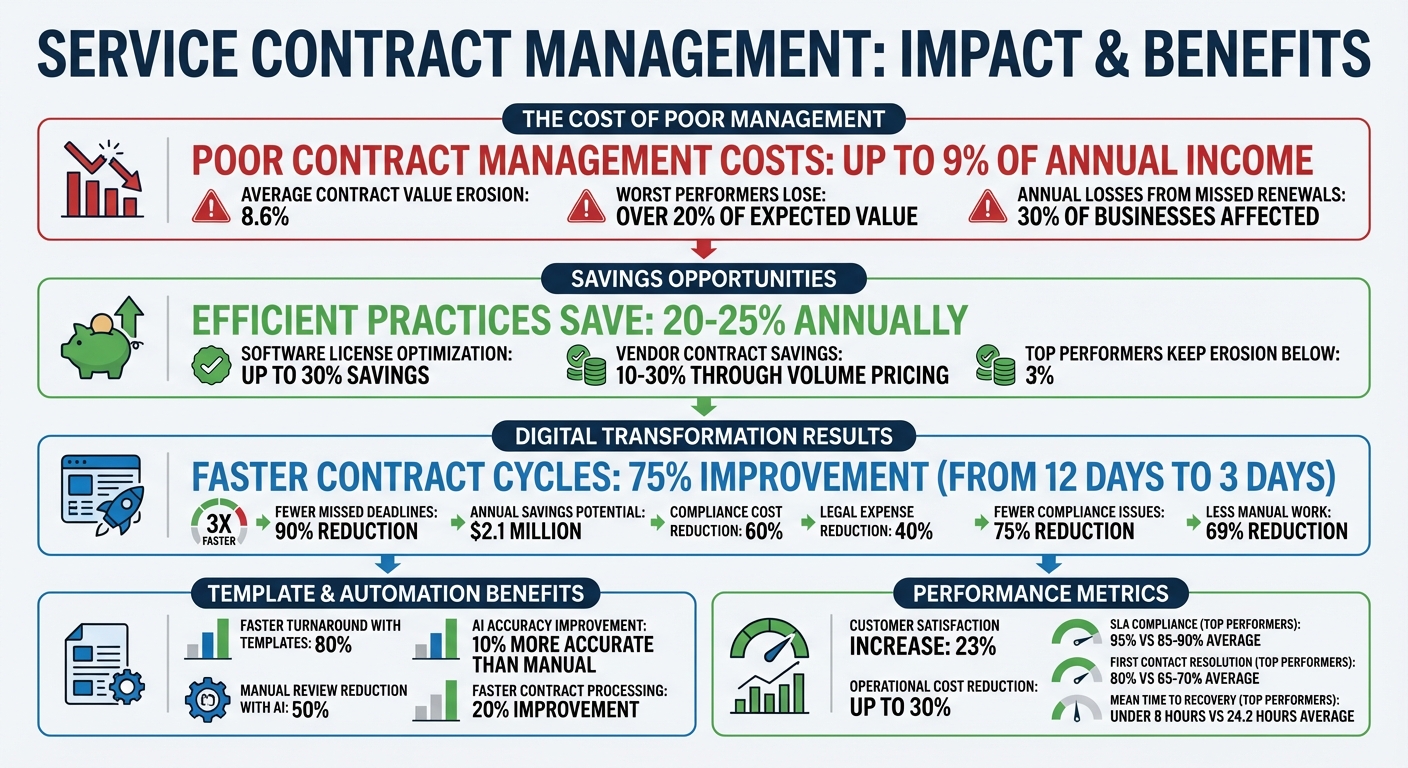
Service contract management is critical for businesses to control costs, reduce risks, and ensure compliance. Poor management can cost organizations up to 9% of their annual income, while efficient practices can save 20–25%, especially by optimizing software licenses and centralizing contract tracking. Here's a quick summary of how to improve service contract management:
- Define Roles and Responsibilities: Assign clear ownership across all contract stages - drafting, negotiation, execution, monitoring, and renewal - to avoid overlap and missed deadlines.
- Standardize Contract Creation: Use pre-approved templates to reduce errors, speed up processes, and ensure consistency across agreements.
- Centralize Tracking: Store all contracts in a single repository for easy access, automated alerts, and improved compliance.
- Monitor Performance: Track vendor performance using measurable KPIs like SLA compliance and cost per ticket to minimize value erosion.
- Automate Renewals: Use automated notifications and integrated IT tools to avoid missed deadlines and ensure data-driven renewal decisions.
Switching to digital systems and automation can lead to 90% fewer missed deadlines, 75% faster contract cycles, and up to $2.1 million in annual savings. Start by centralizing high-value contracts and implementing structured processes to transform contract management into a streamlined, cost-saving strategy.
Service Contract Management: Key Statistics and ROI Benefits
Procurement Contract Management 101: Contract Management Expert Breakdown
Define Roles and Responsibilities
When multiple departments juggle contracts without clear ownership, chaos often follows. Between 60% and 80% of all business activities rely on contracts and agreements, yet many organizations falter because no one takes charge of specific stages. The consequences? Missed deadlines, duplicated efforts, and contracts slipping through the cracks.
"Clearly defining who is responsible for each aspect of the contract lifecycle... prevents overlap and confusion, which allows team members to perform tasks more competently and promptly." - Freshworks
To avoid these pitfalls, it's essential to assign clear ownership across the five key stages of a contract's lifecycle: drafting, negotiation, execution, monitoring, and renewal. For instance, when IT managers focus on technical requirements and procurement teams lead vendor negotiations, tasks flow smoothly without redundancy. This clarity also speeds up communication - stakeholders know exactly who to contact for pricing inquiries, compliance concerns, or performance updates, cutting out the guesswork.
Clear roles not only streamline operations but also pave the way for assigning stakeholders to take charge of critical contract stages.
The financial benefits of role clarity are hard to ignore. Companies that adopt best practices for managing software licenses can slash expenses by up to 30%. These savings stem from having dedicated individuals track usage, identify idle resources, and manage renewals effectively.
Key Stakeholders in Service Contract Management
Every role in contract management plays a vital part in ensuring the process runs smoothly. Legal teams handle the initial drafts, using standardized templates and addressing clauses around liability, dispute resolution, and compliance. Procurement teams lead vendor research, negotiate pricing and service level agreements (SLAs), and manage renewals. IT managers focus on technical specifications, system integration, and tracking performance metrics like uptime and response times.
Meanwhile, finance teams oversee budgets, conduct cost analyses, and manage invoicing to avoid payment delays that could breach contracts. Contract managers act as the glue, coordinating the entire lifecycle and ensuring all terms are met. In service-heavy industries, field technicians handle on-site deliverables and document asset conditions. For them, quick access to contract terms is critical to avoid "contract leakage", where services beyond the agreement are unintentionally provided.
Here’s a breakdown of the primary stakeholders and their responsibilities:
| Role | Primary Responsibility | Key Stage Involvement |
|---|---|---|
| Legal Team | Drafting, compliance, and risk management | Drafting, Negotiation, Approval |
| Procurement | Vendor selection, pricing, and negotiations | Acquisition, Negotiation, Renewal |
| IT Manager | Technical integration and performance tracking | Planning, Operation, Maintenance |
| Finance | Budgeting, ROI analysis, and payments | Planning, Implementation, Renewal |
| Contract Manager | Overseeing lifecycle and ensuring compliance | All Stages |
Defining these responsibilities upfront establishes accountability and minimizes risks. For example, when high-value contracts require executive approval, everyone knows the escalation process. If technical issues arise during implementation, IT can step in without waiting for input from legal or finance. This structured approach turns contract management into a coordinated effort, where each stakeholder brings their expertise to the table at the right moment.
With roles clearly defined, organizations can take the next step: standardizing processes and centralizing tracking to make contract management even more efficient.
Standardize Contract Creation and Negotiation
Starting every contract from scratch wastes time and effort. Organizations with well-organized contract management systems report 20% faster contract cycles and 75% fewer compliance issues. By adopting a standardized approach to drafting and negotiating agreements, processes that once dragged on for days can now be completed in minutes.
But standardization doesn’t mean inflexibility. It’s about creating pre-approved language and negotiation strategies that teams can use and adapt as needed. This approach eliminates common issues like inconsistent terms, missing clauses, and drawn-out legal reviews.
For instance, when procurement teams rely on consistent templates for vendor agreements, approvals become quicker because everyone knows what to expect. Deviations from the standard terms are immediately noticeable, reducing delays. This familiarity also helps prevent "contract leakage", where services are provided without a clear, enforceable agreement.
Using Pre-Approved Templates
Legal-approved templates can turn contract creation into a smooth process. Instead of waiting days for legal teams to draft agreements, sales or procurement teams can generate contracts in minutes using pre-approved language. This shift can lead to 80% faster turnaround times, with AI and standardized templates cutting manual review efforts by 50%.
Templates don’t just save time - they also ensure every contract includes critical clauses, like liability caps, data security requirements, and termination rights. These safeguards are no longer left to memory. AI-powered contract analysis, for example, can be 10% more accurate than manual reviews.
Here’s a quick comparison of manual versus template-based contract creation:
| Feature | Manual Contract Creation | Template-Based Creation |
|---|---|---|
| Drafting Time | High (Hours/Days) | Low (Minutes) |
| Risk of Error | High (Manual entry) | Low (Pre-approved terms) |
| Legal Involvement | Needed for every draft | Needed only for exceptions |
| Consistency | Low (Varies by author) | High (Standardized) |
| Negotiation Speed | Slow (Custom terms) | Fast (Pre-set terms) |
To make the most of templates, build a clause library alongside them. This gives negotiators pre-approved fallback options when vendors push back on standard terms. For example, if a vendor objects to a 99.9% uptime SLA, your team can quickly offer a pre-approved 99.5% SLA with adjusted service credits. Using digital intake forms to collect details upfront - like vendor names, contract values, and service descriptions - can automatically populate templates, saving even more time.
"Implementation was very smooth. Using the bulk upload feature, all contracts were integrated into the system within minutes. I was also able to see the AI-extracted metadata on the tool immediately, which was impressive."
– Mayuri Jaltare, Company Secretary, Qapita
To keep templates effective, review and update them annually. Changes in regulations or business needs may require adjustments to standard terms. Clearly define which contracts can use templates alone and which require legal review based on factors like value or risk.
Once templates are in place, the focus can shift to negotiating terms that protect your organization.
Negotiating Key Contract Terms
Even with strong templates, negotiation is still essential. The goal is to secure terms that protect your organization while maintaining a productive vendor relationship. Pay close attention to critical clauses like scope of services, SLAs, liability caps, payment terms, and termination rights.
- Scope of Services: Define deliverables, performance standards, and timelines clearly. For example, in a help desk support contract, specify response times for different priorities, hours of coverage (e.g., 24/7 or business hours), and whether the vendor handles tasks like password resets or hardware troubleshooting. Avoid vague terms like "general IT support" that can lead to disputes.
- Service Level Agreements (SLAs): Make promises measurable. Uptime targets often range from 99.5% to 99.9%. Negotiate service credits (usually 10% to 50% of monthly fees) for failing to meet these targets.
- Limitation of Liability: These clauses cap the vendor’s financial exposure, typically at 12 to 24 months of fees paid. Push for "uncapped" liability in cases like intellectual property infringement or data breaches. While a legal review might cost between $2,000 and $10,000, it can prevent errors that could cost between $50,000 and $500,000.
- Payment Terms: While Net 30 is common, negotiating Net 60 can improve cash flow. Also, capping annual price increases at 3% to 5% helps control costs. Vendor contracts can deliver 10% to 30% savings through volume pricing and multi-year commitments.
- Termination Rights: Build in flexibility, such as a 30-day notice period for termination without cause. Include clear terms for termination in cases of vendor breaches or insolvency. Make sure the exit strategy guarantees data portability (e.g., export in CSV or JSON formats) and offers transition assistance for 30 to 90 days to avoid vendor lock-in.
One effective tactic is to negotiate with multiple vendors at the same time. This creates competition, often leading to better pricing and terms. Additionally, incorporate the winning vendor’s RFP responses into the contract to ensure their promises become enforceable.
"The winning vendor's proposal is not supposed to be a marketing bluff: clients do rely upon the representations and promises made in such documents, and the successful proponent should be held accountable."
– Lisa R. Lifshitz, Partner, Torkin Manes LLP
With standardized contracts and smart negotiation strategies in place, the next step is centralizing storage and tracking to ensure agreements remain accessible and enforceable.
Centralize Contract Tracking and Visibility
Scattered contracts can drain valuable time and disrupt critical decision-making. When contracts are tucked away in filing cabinets, personal hard drives, or buried in email threads, accessing essential details becomes a frustrating challenge. Paul Bagley, Director of Commercial Contracting at Acosta, sums it up perfectly:
"When you save a contract to a drive, it's still essentially lost." - Paul Bagley, Director of Commercial Contracting, Acosta
This lack of organization can cost businesses up to 9% of their annual revenue due to inefficient contract management.
By consolidating agreements into a centralized repository, businesses create a single source of truth for all contracts. This means no more searching through endless folders - teams can instantly access key terms, renewal dates, and obligations. Companies with streamlined contract management processes report 20% faster contract cycles and 75% fewer compliance issues.
AdminRemix's AssetRemix offers IT teams a unified platform to manage contracts for everything from software maintenance to hardware leases. For $99/month or $999/year, the platform provides unlimited asset tracking and centralized visibility, making it easier to oversee vendor relationships. Its help desk integration ensures that contract details are always accessible when support teams need them. This centralized approach not only simplifies management but also delivers measurable improvements in efficiency and compliance.
Benefits of a Centralized Repository
A centralized contract system shifts management from reactive to proactive. Automated alerts - triggered 90, 60, and 30 days before a contract expires - help avoid surprise renewals and enable timely negotiations. Additionally, real-time financial insights prevent budget overruns. For example, alerts can notify teams when 80% of a contract's budget has been used, giving them time to address potential issues before costs escalate. This level of control can reduce revenue loss by an estimated 8% to 12%.
Compliance becomes easier, too. A centralized system provides a complete audit trail, with timestamped records for every contract amendment and approval. This ensures adherence to regulations like GDPR, HIPAA, or SOX, cutting compliance costs by 60% and legal expenses by 40%.
Manual vs. Digital Tracking
The difference between manual and digital contract tracking isn’t just about convenience - it directly impacts risk and efficiency. Manual methods rely on scattered documents and outdated processes, while digital systems offer automation and instant access. Here’s how they compare:
| Feature | Manual Tracking | Digital Tracking |
|---|---|---|
| Storage | Spread across filing cabinets, shared drives, and emails | Centralized cloud repository with role-based access |
| Renewal Management | High risk of missed deadlines and auto-renewals | Automated alerts at 90, 60, and 30-day intervals |
| Searchability | Time-consuming manual searches | Instant access with metadata tagging and keyword search |
| Version Control | Conflicting versions; no clarity on the latest | Timestamped audit trails ensure accuracy |
| Compliance | Inconsistent reviews; hard to prove compliance | Automated monitoring and audit-ready records |
| Processing Time | Labor-intensive and slow | 75% faster contract processing |
This comparison underscores how digital tracking reduces risks and administrative burdens. Companies using modern systems report 3x faster contract cycles and 69% less manual work. For a business with $2 million in annual revenue, manual tracking can cost up to $50,000 per year due to "ghost assets" - items paid for but unaccounted for.
Switching from manual to digital tracking doesn’t have to happen all at once. Start by centralizing high-value contracts, then gradually expand to include all vendor agreements. Use consistent metadata tagging - such as vendor name, contract type, and expiration date - to keep contracts searchable and organized as your system grows.
Centralizing contracts isn’t just about better organization - it’s a foundational step toward improving monitoring, ensuring compliance, and staying ahead of renewals. With a centralized system, IT teams can effectively track vendor performance and secure the value promised in each agreement.
sbb-itb-c68f633
Monitor Performance and Optimize Contracts
Centralizing contracts is just the first step; the real game-changer lies in tracking vendor performance. Without consistent monitoring, businesses risk losing significant revenue. On average, 8.6% of contract value erodes due to poor performance, with some organizations losing over 20% of expected value. In contrast, top-performing businesses manage to keep this erosion below 3% by actively measuring and optimizing their contracts.
Performance tracking isn’t just about identifying problems - it’s about understanding their root causes. For instance, if a vendor misses deadlines or overshoots budgets, tracking data can reveal whether the issue stems from unclear requirements, resource shortages, or process inefficiencies. This shift from reactive troubleshooting to proactive problem-solving strengthens vendor relationships. Companies that track IT support metrics effectively report 23% higher customer satisfaction rates and cut operational costs by up to 30%. These insights pave the way for measuring critical contract metrics that drive improvement.
Key Performance Indicators for Service Contracts
To turn abstract concerns into actionable steps, measurable metrics are essential. Financial KPIs like Annualized Contract Value (ACV) ensure renewal rates stay competitive, while Order Value Variance (OVV) helps detect and control scope creep before it strains budgets. Another important metric, Terminated Contract Remaining Value (TRV), safeguards against revenue loss from unbilled work during contract terminations.
Service quality metrics are just as critical. Take SLA Compliance Rate, for example - it tracks whether vendors meet agreed-upon timeframes. While the industry average lands around 85-90%, top performers hit an impressive 95%. Another key metric, Mean Time to Recovery (MTTR), measures how quickly vendors resolve service failures. Leading businesses achieve recovery times under 8 hours, compared to the industry average of 24.2 hours. Similarly, First Contact Resolution (FCR) evaluates problem-solving efficiency, with top vendors resolving 80% of issues on the first try, far exceeding the 65-70% industry baseline.
For IT teams juggling multiple service contracts, Cost per Ticket offers a clear view of financial efficiency. With IT support teams handling an average of 492 tickets per month, even minor improvements in this metric can lead to substantial savings.
Using Data for Continuous Improvement
Performance reviews are only valuable if they lead to actionable insights. Sharing performance data with vendors before scheduled reviews gives them time to prepare and address missed goals. This collaborative approach often yields better results. As ServiceChannel explains:
"A good vendor is hard to find, so you don't want to resort to contract reductions too quickly. Knowing [performance data] can help you work with your suppliers to improve their services before you resort to contract renegotiation."
If a vendor’s performance continues to fall short, consider implementing a Performance Improvement Plan (PIP) with clear milestones. Should there still be no progress, use the data as leverage for renegotiating or terminating the contract.
Tools like AdminRemix's AssetRemix platform simplify this process by centralizing contract data alongside asset performance records. For example, when support tickets reference specific vendor agreements, teams can instantly check whether response times and resolutions align with SLA commitments. This transparency helps prevent "contract leakage", where work is performed but goes unbilled because technicians can’t verify entitlements on-site. By linking contract terms directly to operational data, AssetRemix turns performance monitoring into an ongoing, strategic effort. This continuous oversight ensures proactive vendor management while complementing efficient contract tracking.
Automate Renewal and Compliance Processes
Relying on manual contract tracking often leads to costly mistakes. Nearly 30% of businesses lose money annually because of missed or poorly managed contract renewals. Why? Disorganized spreadsheets, endless email threads, and the assumption that someone will manually track renewal dates are the usual culprits. Automation steps in to eliminate these risks by replacing human memory with system-driven workflows, ensuring no critical deadlines are overlooked.
The financial benefits are clear. Teams using automated renewal alerts report up to 90% fewer missed deadlines and 50% faster review cycles. But the real value lies in the time automation provides. It allows teams to audit actual usage, renegotiate unfavorable terms, or cancel services that no longer meet their needs - all before contracts auto-renew at higher rates. Plus, these systems integrate seamlessly with other digital tools, paving the way for smoother operations.
Using Automated Notifications
When it comes to contract renewals, timing is everything. Automated notifications ensure you never miss a critical deadline by not only tracking expiration dates but also accounting for the notice periods hidden in contract fine print - often 30 to 90 days before the contract ends. Missing this window could lock you into another term, even if the vendor’s performance has been disappointing or your requirements have shifted.
Modern systems use AI to identify clauses like "auto-renew", "termination", and "price escalation", scheduling reminders based on the notice periods they uncover. This eliminates the need for time-consuming manual searches. For instance, 61% of contract professionals still manually search for contracts every week just to prepare for renewals. Automation ensures these alerts reach the right people - whether in Legal, Finance, or Procurement - so critical deadlines don’t get lost in cluttered inboxes.
Escalation rules offer another safeguard. If a renewal or approval task remains untouched for 48 hours, the system automatically escalates it to department heads. This prevents delays that could turn a manageable 12-day process into a last-minute scramble. Companies using automated routing have reduced contract turnaround times from an average of 12 days to just 3 days.
And it doesn’t stop at alerts. Integrating these systems with IT management tools adds another layer of insight, making contract decisions smarter and more data-driven.
Integration with IT Management Tools
Renewal alerts are just one piece of the puzzle. Without insights into actual usage, IT teams risk renewing software licenses that no one is using. By connecting contract management systems with IT Asset Management (ITAM) tools like AdminRemix's AssetRemix, businesses can close this gap. For instance, when a 60-day renewal alert is triggered, teams can immediately pull usage data to see if they’re paying for 100 licenses when only 60 are active. This integration works alongside the centralized contract system, ensuring every renewal decision is backed by accurate, real-time data.
This connection also strengthens compliance tracking. Tools like AssetRemix link contract terms directly to operational data. For example, if a support ticket references a vendor agreement, teams can instantly verify whether the vendor is meeting SLA commitments, such as response times and resolutions. Through this integrated approach, organizations report 75% fewer compliance issues.
Equally important is the audit trail. Every action - whether it’s an amendment, approval, or usage review - is logged automatically. This creates a transparent record that simplifies compliance reviews and eliminates the chaos of piecing together decisions when auditors come calling. Such documentation also provides the evidence needed to justify renegotiations or contract terminations, basing decisions on hard data rather than guesswork.
Conclusion
Managing service contracts effectively can turn potential financial pitfalls into valuable opportunities. The distinction between companies that lose money due to missed renewals and those that save 20% to 25% annually boils down to four key elements: well-defined processes, centralized tracking, performance monitoring, and automation. When these components work in harmony, contracts shift from being liabilities to strategic tools that enhance operational efficiency.
Organizations with advanced systems report average annual savings of $2.1 million and a 60% reduction in compliance costs. Moving from manual spreadsheets to digital systems creates a centralized and reliable source of truth. As Paul Bagley, Director of Commercial Contracting at Acosta, puts it:
"When you save a contract to a drive, it's still essentially lost." - Paul Bagley, Director of Commercial Contracting, Acosta
A centralized repository coupled with automated workflows ensures quick and accurate access to critical information. This approach not only simplifies operations but also aligns contract management with real-time asset performance, ensuring better decision-making.
For IT teams handling software licenses and vendor agreements, tools like AdminRemix's AssetRemix can bridge the gap between contract terms and actual usage data. By linking contract details with asset performance, teams can make informed renewal decisions, avoiding situations where they overpay for unused licenses. This integration supports the entire contract lifecycle, from initial tracking to compliance monitoring and renewal optimization.
To get started, focus on defining clear contract ownership, standardizing templates, and setting automated renewal reminders at 90, 60, and 30 days before expiration. These initial steps help prevent costly errors and pave the way for more advanced improvements down the road.
FAQs
How does assigning clear roles and responsibilities improve service contract management?
Assigning well-defined roles and responsibilities is key to managing service contracts smoothly and efficiently. When team members clearly understand who handles tasks like tracking licenses, generating reports, or overseeing risk assessments, it minimizes confusion, avoids overlapping efforts, and keeps everything running on schedule.
This clarity also makes monitoring and escalation processes much more straightforward. By assigning specific individuals or teams to tasks such as performance tracking or resolving disputes, organizations can set clear expectations, spot issues quickly, and address them without delay. Having a structured framework in place not only helps maintain compliance with service-level agreements but also simplifies processes like contract renewals or terminations, ensuring that contract management stays organized and hassle-free.
What are the advantages of using standardized templates for service contracts?
Using standardized templates for service contracts brings a host of advantages. For starters, they streamline workflows, promote uniformity across agreements, and cut down the time it takes to draft and finalize contracts. This approach not only reduces the chances of mistakes but also makes the entire process more straightforward for everyone involved.
With a standardized format in place, businesses can concentrate on customizing the specific terms of the contract while relying on a pre-approved structure that aligns with legal and operational requirements. The result? Saved time, clearer communication, and easier negotiations for all parties.
How can automating contract renewals help reduce compliance risks?
Automating contract renewal processes ensures you never miss critical deadlines by generating timely reminders and alerts. Plus, it centralizes all contract data, making it simpler to track and manage renewal timelines without hassle.
By creating standardized approval workflows and cutting down on manual errors, automation reduces the risk of regulatory slip-ups and keeps your organization in line with legal and contractual requirements. This efficient system not only saves valuable time but also adds an extra layer of confidence for your team.