
Ultimate Guide to Empathy in IT Support
Empathy in IT support is about understanding the human impact of technical problems and prioritizing user needs. When systems fail, users face stress, missed deadlines, and lost productivity. Support teams that focus on empathy build trust, resolve issues faster, and improve user satisfaction.
Key takeaways:
- Empathy improves problem-solving: Understanding users' feelings helps IT teams address issues effectively and prevent recurring problems.
- Better business outcomes: Companies prioritizing empathy see higher growth and earnings, with empathetic leadership boosting creativity and reducing burnout.
- Practical tools and techniques: Empathy training, clear communication, and user-centered workflows enhance both team dynamics and user experiences.
- Balancing automation and human touch: Automation handles repetitive tasks, while empathetic human support addresses complex or sensitive issues.
Empathy transforms IT support into a user-focused, trust-building function that drives both personal and organizational success.
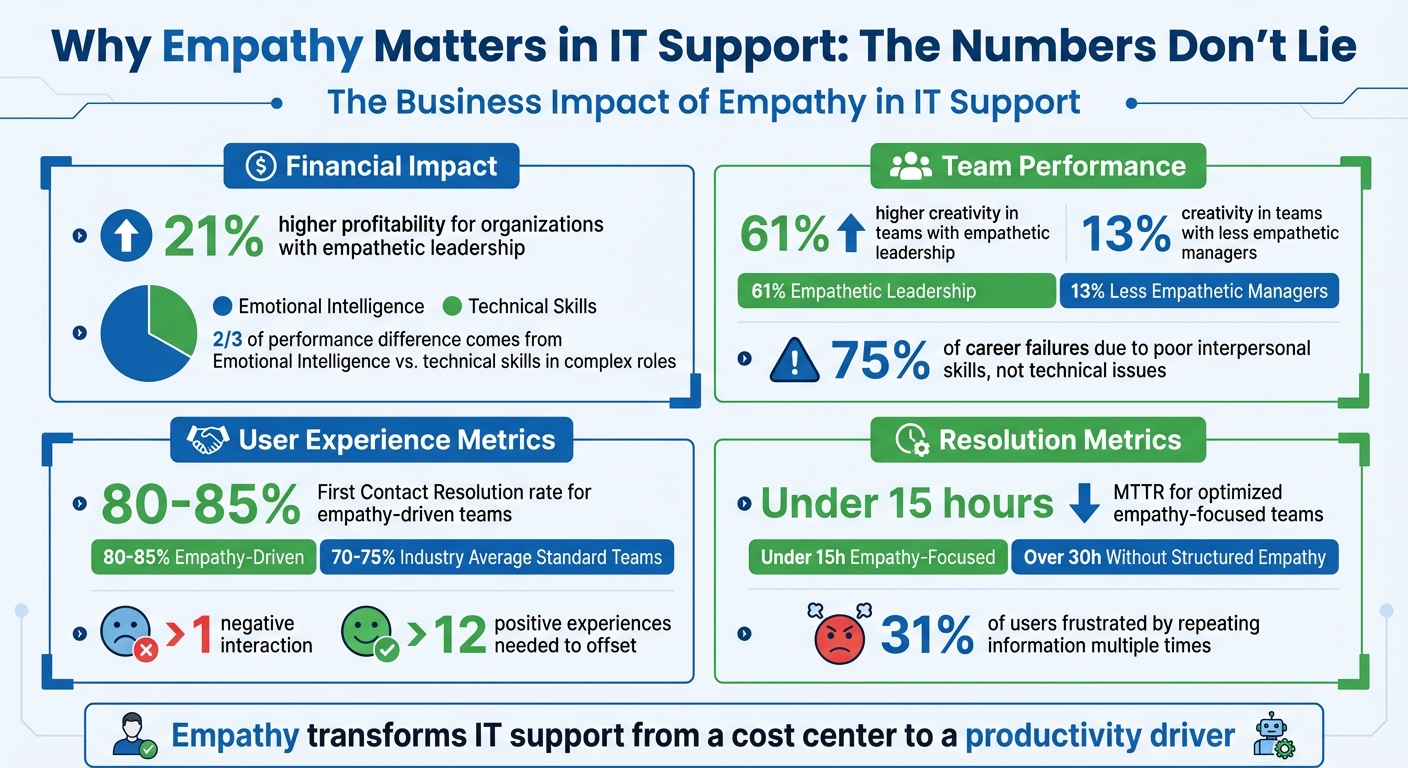
The Business Impact of Empathy in IT Support: Key Statistics
Five Empathy Improvement Techniques in an IT Customer Service Course
sbb-itb-c68f633
The Benefits of Empathy in IT Support
Empathy in IT support plays a key role in improving user satisfaction, operational processes, and team dynamics. Research shows that organizations with leaders who prioritize emotional intelligence see up to 21% higher profitability, and two-thirds of the difference between average and top performers in complex roles comes from Emotional Intelligence rather than technical expertise.
Better User Satisfaction and Retention
When IT teams respond with empathy, they can turn potentially frustrating situations into positive experiences. This approach encourages users to report problems early, helping to prevent small issues from escalating into major system failures.
Empathy also leads to more effective solutions. Technicians who take the time to understand a user's workflow are better equipped to address the root causes of problems, reducing the likelihood of recurring issues. This human-centered approach sends a clear message that the organization values its employees' time and well-being. In today’s competitive job market, this kind of care can make a big difference in employee retention.
"A frustrated and angry user can rarely put their feelings aside, and often continues to feel the impact of the frustration for some time even after resolution." - Aaron Flack, Conosco
By fostering better interactions, empathetic support naturally speeds up troubleshooting and leads to quicker resolutions.
Faster Problem Resolution
Empathy not only improves user satisfaction but also helps IT teams resolve issues more efficiently. When support staff ask targeted questions like "What is this stopping you from doing right now?" they can better understand the urgency of the problem based on its actual business impact, avoiding unnecessary guesswork. This approach minimizes misdiagnoses and ensures resources are allocated more effectively.
Empathetic IT support also reduces escalations to management and often includes educational elements that empower users to resolve smaller issues independently, which decreases the volume of repeat tickets.
"Empathy is uptime for relationships. When clients feel heard, they build trust, escalate less, and stick with you longer." - Helpt
The statistics are clear: 75% of careers falter due to poor interpersonal skills rather than technical shortcomings, and it can take up to 12 positive experiences to offset a single negative one caused by a lack of empathy.
Stronger Team Culture and Collaboration
Empathy doesn’t just enhance external interactions - it also strengthens IT teams internally. Empathetic leadership fosters innovation, with 61% of teams under such leadership reporting higher creativity, compared to just 13% for teams led by less empathetic managers.
"Collaboration requires compromise and compromise requires understanding. For your organization to grow, everyone must commit to empathetic communication – from your CEO to your interns." - Kevin Dattolico, CEO of Americas at Syntax
An empathy-first culture reduces stress and the constant urgency that can lead to burnout. Instead of always reacting to problems, teams can focus on proactive solutions that prevent issues from arising in the first place. This creates a sense of psychological safety, allowing IT professionals to thrive. It also makes the department more appealing to potential hires, which is crucial in a competitive job market. Together, these factors build a culture of empathy that benefits both users and IT teams.
How to Build Empathy in IT Support
Empathy is a game-changer in IT support, helping users feel heard while also resolving issues effectively. Building empathy into IT support isn’t just about being nice - it’s about creating structured processes that ensure every interaction feels personal. This involves focusing on training, communication techniques, and workflows that balance emotional understanding with technical problem-solving.
Empathy Training for IT Professionals
Empathy training should revolve around three main ideas: Recognition (understanding the user's emotions), Validation (acknowledging their feelings), and Responsiveness (acting in a way that reflects this understanding). Research shows that when emotions are addressed first, users are more cooperative and less defensive, which helps prevent issues from escalating and speeds up problem resolution.
Hiring processes can also play a role. Instead of traditional interviews, consider exercises like the "silent ticket" test. In this test, candidates receive a vague support request to see if they focus on understanding the user’s needs before jumping to conclusions. This approach emphasizes emotional intelligence as a key qualification for IT roles.
Encourage self-awareness among team members by having them reflect on their performance after challenging interactions. Did they respond with empathy, or were they defensive? Recognize and reward empathetic behavior through peer shout-outs or customer satisfaction (CSAT) highlights during team meetings. This reinforces the idea that how users are treated matters just as much as the speed of ticket resolution.
By embedding empathy into training, IT professionals can better connect with users and address their concerns more effectively.
Using Empathetic Communication Techniques
The way IT teams communicate can make or break the user experience. Structuring conversations to address emotions before diving into solutions is key. Simple validating phrases like "I understand why this is frustrating" or "That makes sense" can reduce tension and build trust.
Here’s how empathetic language can be applied in common scenarios:
| Scenario | Empathetic Phrase/Technique |
|---|---|
| Technical Issue | "I know how disruptive this is when you're trying to get work done. Let's fix this together." |
| System Delay | "I understand timing is important and I'm sorry this is taking longer than expected." |
| User Confusion | "That's a great question. It's not always intuitive; let's walk through it step-by-step." |
| Help Desk Error | "That's on us. We should have handled that better. I apologize for the oversight." |
| Urgent Request | "I can see why this feels urgent. I'm addressing this as a priority." |
"Empathy doesn't slow down support. It accelerates it." – TextExpander
Tools like TextExpander allow teams to use pre-written empathetic phrases, helping maintain a consistent tone even under pressure. Avoid overwhelming users with technical jargon - this can make them feel dismissed. Instead, give them room to explain their concerns fully, which often leads to faster and more effective solutions.
When empathetic communication becomes second nature, IT teams can handle even tough situations with ease.
Designing User-Centered Support Workflows
Empathy shouldn’t just be a personal skill - it needs to be baked into the way IT support operates. By incorporating empathy into Standard Operating Procedures (SOPs), teams can deliver consistent, user-first support. A simple framework like Acknowledge → Clarify → Resolve → Reassure can guide every interaction, ensuring no step is overlooked.
For example, asking diagnostic questions like "What is this stopping you from doing right now?" helps prioritize issues based on their impact, rather than just focusing on error codes. This approach reduces misdiagnoses and ensures resources are allocated effectively. Help desk macros and quality assurance (QA) scorecards can also include steps for emotional acknowledgment, making empathy a measurable part of performance.
Shift the focus from just closing tickets to managing how users feel throughout the interaction. Instead of asking, "What went wrong?" during performance reviews, try asking, "Who did you support this week?" This subtle shift reinforces a culture where empathy is seen as a strength - and one that sets your team apart from competitors.
Balancing Automation with Human Support
Automation is great for handling repetitive tasks, but when it comes to more complex or emotionally sensitive issues, human interaction is essential. In fact, research shows that 75% of customer experience leaders believe AI enhances human intelligence rather than replacing it. By automating routine processes, IT teams can focus more on delivering empathetic support, which is critical for maintaining strong connections with users.
When to Use Automation vs. Human Support
Striking the right balance between efficiency and empathy means knowing when to rely on automation and when to bring in human expertise. Automation works best for straightforward, transactional tasks like password resets, answering FAQs, or routing tickets - areas where speed and availability are top priorities. On the other hand, human support is ideal for situations that are ambiguous, emotionally charged, or require creativity and judgment.
The numbers speak for themselves: while 51% of consumers are fine with bots for immediate tasks, 67% prefer human help for complex or emotionally sensitive issues. Automation shines in areas like consistency and speed, but humans excel at understanding tone, building trust, and navigating tricky situations.
Think of AI as a tool that lightens the load for your team. By handling tasks like triage and summarization, automation allows agents to focus on high-value, empathetic interactions. Transparency is key here - users should always know whether they’re interacting with a bot or a human, and it should be easy for them to escalate to a person when needed.
Designing Smooth Escalation Processes
A well-designed escalation process ensures that users don’t feel ignored or frustrated during the transition from automation to human support. The handoff is a critical moment - done poorly, it can erode trust. Research highlights this pain point: 31% of users find having to repeat information multiple times one of the most frustrating aspects of support. To avoid this, make sure all data collected by the automated system - like chat history, user intent, and issue details - is passed seamlessly to the human agent.
Using sentiment-based escalation can make a big difference. For example, if a user expresses frustration with phrases like "This is ridiculous" or "I’ve been waiting forever", the system can automatically route them to a live agent. Proactive SLA escalation rules can also flag tickets for human review before deadlines are missed.
Equip your agents with tools that make their jobs easier, like dashboards that integrate ticket history and AI-generated summaries. This allows them to jump in with empathy and context, rather than wasting time piecing together information.
"The goal is not to automate every decision. The goal is to automate the obvious work well and hand the complicated work to people with full context attached." - Suptask
A smooth handoff underscores your commitment to delivering thoughtful, personalized service.
Measuring Empathy in Automated Systems
To improve empathy in automation, start by measuring it. Sentiment analysis can help adjust tone dynamically and trigger escalation when frustration is detected. Modern AI systems with Natural Language Understanding (NLU) are far better at interpreting intent and nuance compared to older, rigid bots, enabling them to provide responses that feel more human.
Regularly review chatbot transcripts to spot patterns where the AI may have misunderstood users. Use these insights to refine training phrases and intents. Setting tone-of-voice guidelines - whether friendly, professional, or straightforward - can also help your AI align with your team’s approach. Adding personal touches, such as acknowledging previous interactions or addressing users by name, reinforces a sense of empathy.
Keep an eye on metrics like customer satisfaction scores for both automated and human-led interactions. Also, track how often users request to speak with a person. If escalation requests are frequent, it might mean your automation feels too rigid or impersonal. While 48% of consumers say AI has improved customer service experiences, this only holds true when the system is designed with empathy at its core.
Building an Empathy-First IT Support Culture
Focusing on empathy in IT support can make a huge difference. It improves user satisfaction, speeds up problem-solving, and even helps reduce burnout among team members. Research shows that emotional intelligence is a bigger factor than hard skills in determining success for complex roles - two-thirds, to be exact. When empathy becomes a core part of your team's approach, everyone benefits: users feel heard, issues get resolved faster, and agents experience less stress.
Assessing Current IT Support Practices
The first step is identifying where empathy might be missing in your current processes. One way to do this is through "Silent Tickets" - giving agents vague requests to see if they ask clarifying questions or jump straight to assumptions. This helps you understand whether your team naturally leans into curiosity or rushes to find solutions. Another tool is the "Empathy Curve", where agents self-rate their emotional approach after tough interactions. This builds self-awareness and helps managers spot patterns in how agents handle stress.
You’ll also need feedback directly from users. Conduct 5–10 user interviews and 2–3 hours of shadowing for each major project. This kind of hands-on engagement reveals issues that technical logs and IT asset management data might miss - such as confusing interfaces or workflow problems that frustrate users every day. Tools like Empathy Maps (tracking what users say, think, do, and feel) and User Journey Maps (pinpointing where users feel overwhelmed during tech failures) can turn vague complaints into actionable insights. These steps help you build a foundation for weaving empathy into every support interaction.
Steps to Develop Empathy Across Teams
Once you’ve identified gaps, it’s time to take action. Use a four-step framework to make empathy part of daily operations: Acknowledge (validate the user’s stress), Clarify (ask what the issue is stopping them from doing), Resolve (address the problem), and Reassure (confirm the next steps). This process ensures consistency while allowing agents to personalize their responses.
Collaboration with other departments is also key. Regular meetings with teams like marketing or product development can help IT understand what users were promised and align support accordingly. Role-playing exercises and simulations are another great way for agents to practice handling everything from irate users to high-stakes outages.
Even your hiring process can emphasize empathy. Instead of focusing solely on technical skills, try "empathy auditions", where candidates are evaluated on how well they ask thoughtful questions about the team and clients. Look for people who can read emotions - even in silence or text - and who approach conflict with curiosity rather than defensiveness. After all, studies show that 75% of career failures are due to poor interpersonal skills, not technical shortcomings.
Tracking Success and Continuous Improvement
Once empathy-focused practices are in place, tracking progress is vital. Add an "empathy category" to peer or team lead reviews to measure how often agents acknowledge emotions, match tone, and anticipate user needs. While this approach might slightly slow initial responses, it tends to improve First Contact Resolution (FCR). Top organizations with empathy-driven strategies hit FCR rates of 80–85%, compared to the industry average of 70–75%.
Pay attention to agent satisfaction and retention rates as well - they’re strong indicators of a healthy team culture. Kristin Aardsma from Basecamp highlights the importance of this:
"It's not the work itself that creates high churn and apathy in support positions; it's how you treat the employees".
Celebrate empathetic behavior with peer recognition programs like "calm-under-fire" nominations or "hero badges". Share positive customer feedback during team meetings to make empathy a visible and valued part of your culture.
Finally, review metrics like Mean Time to Resolution (MTTR) and FCR monthly instead of daily. This helps identify whether delays are caused by technical issues or communication gaps. For reference, companies without structured systems often average over 30 hours MTTR, while optimized teams achieve under 15 hours. Shift one-on-one meetings to focus on positive outcomes - ask managers to discuss who the agent supported that week rather than just what went wrong. These reviews help keep empathy front and center in your operations.
Conclusion: How Empathy Transforms IT Support
Empathy has the power to reshape IT support in ways that go beyond just fixing technical problems. By fostering a shift from reactive fixes to proactive problem-solving, IT teams can minimize downtime, prevent recurring issues, and design systems that align with what users actually need. Organizations that embrace empathy as a core principle often find themselves excelling in both operational efficiency and financial performance compared to their competitors.
When IT teams truly understand their users, they move past the dismissive "PEBKAC" mindset and instead build genuine partnerships. This creates an environment where users feel comfortable reporting small issues before they escalate and gain confidence through patient education. As a result, IT teams benefit from a healthier work atmosphere, and support evolves from being a cost burden to a driver of productivity.
The secret lies in realizing that users care about achieving their goals, not just resolving technical glitches. By using the "Listen, Educate, Resolve" framework, IT teams can balance automation for routine tasks with the human touch needed for complex issues. While AI can handle repetitive jobs, human interaction brings the nuance and reassurance necessary for more complicated problems. Organizations that strike this balance don’t just solve problems - they empower users and create workplaces where technology becomes an enabler of success rather than an obstacle.
Adopting an empathy-first mindset can transform IT support into a cornerstone of a better, more connected workplace experience.
FAQs
How do you train empathy without slowing down ticket resolution?
Make empathy a core part of your team's approach by weaving it into daily procedures and recruitment strategies. Train staff to recognize emotional cues and grasp the context of a customer's situation before jumping to solutions. This not only builds trust but also helps prevent unnecessary escalations.
When hiring, treat interviews as opportunities to gauge emotional intelligence - think of them as "empathy auditions." By prioritizing candidates who demonstrate strong interpersonal skills, you set the stage for a team that delivers thoughtful, people-focused service. Incorporating empathy into workflows doesn’t have to slow down ticket resolution; instead, it ensures every interaction feels personal and genuine.
What metrics best measure empathy in IT support?
Empathy in IT support can be assessed by reviewing conversations for specific cues. For example, does the support agent acknowledge the customer's emotions? Are they adjusting their tone to match the customer's mood? And most importantly, are they offering solutions that directly address the issue at hand? These elements help gauge how effectively a support team understands and responds to customer concerns.
When should a bot hand off to a human agent?
Bots are great for handling straightforward, repetitive tasks, but they should pass the baton to a human agent when things get more complicated or urgent. This includes cases where empathy, a deeper understanding of the issue, or escalating an unresolved problem is necessary. Human agents shine in situations that call for emotional intelligence or detailed problem-solving, areas where bots just can't compete.