5 Benefits of Real-Time IT Asset Monitoring
Real-time IT asset monitoring helps organizations manage their IT infrastructure more efficiently by providing up-to-the-minute data on hardware, software, and network performance. This approach replaces outdated manual tracking methods, offering instant updates and better control over assets. Here’s what you gain:
- Improved Asset Visibility: Access accurate, real-time data, reducing errors and enabling faster issue resolution.
- Reduced Downtime: Detect problems early and prevent costly outages, saving up to $5,600 per minute.
- Cost Savings: Identify unused resources, optimize spending, and avoid unnecessary purchases.
- Simplified Compliance: Automate record-keeping and streamline audits to meet regulatory requirements.
- Informed Decisions: Use live data to manage IT resources effectively and plan maintenance proactively.
These benefits not only cut costs but also help IT teams focus on resolving issues quickly while maintaining system performance. Platforms like AssetRemix make this process easier with features like automated discovery and centralized dashboards, ensuring IT operations run smoothly.
Why Unified IT Operations Makes Asset Management Work
sbb-itb-c68f633
1. Better Visibility and Control Over Assets
Real-time monitoring has revolutionized IT asset management by replacing outdated, error-prone spreadsheets (which often have a 20–30% error rate) with automated systems capable of delivering 98% accuracy. These systems update data in milliseconds, removing the need for guesswork and ensuring teams always have reliable information at their fingertips.
Take Cisco, for example. In June 2023, the company enhanced visibility across its 150,000 endpoints worldwide using Cisco DNA Center. This shift reduced unauthorized device incidents by 65%, dropping from 1,200 to just 420 per month. Spearheaded by Priya Patel, Cisco's Network Security Lead, the initiative incorporated real-time telemetry and policy enforcement, resulting in $800,000 in annual compliance savings.
But visibility is just the beginning. IT teams can now take critical actions remotely - like deploying software, enforcing policies, or wiping devices - directly from centralized dashboards. This capability has proven to cut asset loss by 30–50%, as administrators can address issues in five minutes instead of the usual 24–48 hours. Additionally, real-time monitoring helps organizations reduce shadow IT by 25–40%, blocking unauthorized devices from introducing potential security risks. This level of control not only reduces downtime but also ensures resources are allocated more effectively.
"It allows us to check and update the whereabouts of our fleet. We can pull the Chromebook data, and see if any of the devices are missing or if a device needs to be replaced. The inventory takes less time and we can retrieve data instantly." - Pauline McGinnis, Kipp Indy Public Schools
AssetRemix takes this centralized approach a step further with features like real-time directory synchronization and barcode scanning. These tools allow IT teams to manage unlimited assets from a single dashboard. To ensure security, the platform includes role-based access controls, giving team members access to only the information they need while safeguarding sensitive data.
2. Less Downtime Through Early Problem Detection
Real-time monitoring changes the game for IT operations, shifting from scrambling to fix problems after they occur to staying ahead of them. According to 2023 IDC data, organizations using continuous monitoring see 50% less downtime, saving an average of $5,600 per minute of avoided outages in U.S. enterprises (adjusted for 2026 values). This is possible because monitoring systems keep a close eye on performance metrics like CPU usage, temperature, and network connectivity, spotting anomalies before they cause major disruptions.
This technology is great at catching common issues early. For instance, temperature sensors can flag overheating servers, performance thresholds can reveal memory leaks, and packet loss can identify failing switches. A real-world example? A mid-sized U.S. financial firm reduced server downtime from 8 hours to less than 1 hour per month by using predictive analytics to detect a failing RAID array. This proactive approach prevented data loss during critical trading hours.
By identifying problems early, repairs become quicker and smoother. Platforms like AssetRemix integrate help desk tools with asset databases, giving technicians instant access to a device's full history and specs. They can also reference past tickets for similar issues, cutting mean time to resolution (MTTR) by 40% through reusing proven solutions.
Preventative maintenance also gets a boost. The system tracks each device's last service date and sends automated notifications - via webhooks or email - when maintenance is due or when unexpected changes occur. This reduces emergency repairs, which often eat up 30% of IT budgets. With this continuous monitoring setup, organizations can address technical issues before they escalate, ensuring smoother operations and better-managed IT assets.
3. Lower Costs and Better Resource Use
Real-time IT asset monitoring can uncover hidden expenses, helping organizations trim unnecessary costs. For example, it can identify "ghost" assets - things like unused software licenses, forgotten cloud subscriptions, or idle hardware - that quietly eat away at budgets without offering any value.
Beyond just cutting waste, this kind of monitoring also improves how resources are managed. With centralized dashboards, teams can see exactly what's active, offline, or ready for reassignment - no more guesswork. Plus, bundling related equipment, like pairing a laptop with its charger and case, makes deployments faster and more efficient.
These benefits aren't just theoretical; IT professionals are seeing real results. For instance, Jim Beasley from Llano ISD in Texas shared, "The system is responsive and efficient, but above all, it is cost-effective". Likewise, Arrington Douglas of Malakoff ISD said, "Overall AssetRemix has made my life a lot easier, it has turned our slothful device rollouts into a quick and seamless process". With over 500,000 IT assets managed daily through AssetRemix, the improved visibility translates directly into smarter spending decisions.
Switching from outdated spreadsheets to a centralized system ensures everyone relies on a single source of truth, while proactive alerts help avoid unexpected costs. At $99 per month or $999 annually for unlimited assets and help desk support, the platform quickly proves its worth by preventing unnecessary purchases and missed warranty claims. This straightforward pricing model adds another layer of financial clarity, making real-time IT asset monitoring a wise investment.
4. Easier Compliance and Audit Processes
Meeting the demands of regulations like GDPR, HIPAA, SOX, and NYDFS requires precise, up-to-date records - something manual tracking often struggles to deliver. Real-time monitoring not only ensures compliance with these strict standards but also helps identify unauthorized SaaS application usage. In fact, a striking 80% of employees admit to using such tools without IT approval. By automating record-keeping, organizations can simplify audits and take a more proactive approach to compliance.
With automated updates to asset records, teams can generate compliance reports directly from centralized dashboards, eliminating the need for time-consuming manual evidence collection. This approach not only saves time but also cuts costs. Consider this: 45% of organizations have spent over $1 million on vendor audit expenses within three years, and 23% have incurred costs exceeding $5 million. Real-time license tracking further reduces risks by identifying non-compliant or unauthorized software before vendor audits even take place.
"Incomplete or outdated IT asset records pose a serious risk to compliance, turning what may seem like a small oversight into a costly issue."
– Jon Davis, CISO, Oomnitza
Physical audits are also made simpler with mobile apps that use barcode or QR code scanning, which eliminate manual entry errors and speed up verification. These tools enhance efficiency while supporting proactive compliance efforts. For instance, AdminRemix’s AssetRemix offers a free tier for organizations managing fewer than 50 assets, making it an accessible option for teams starting their automation journey. For larger operations, the platform’s outbound webhooks enable real-time data export to external compliance and reporting tools, ensuring seamless synchronization across systems.
The stakes couldn’t be higher - 32% of cyberattacks stem from vulnerabilities in unpatched devices that organizations fail to track. Real-time monitoring helps detect policy deviations immediately, giving teams the chance to address non-compliance before small issues escalate into major crises.
5. Better Decisions Based on Current Data
Real-time monitoring takes decision-making to a whole new level by replacing outdated spreadsheets and static snapshots with live performance metrics. This means you can see exactly what’s happening with your IT assets at any given moment. Instead of waiting for issues to escalate and cause disruptions, real-time data allows you to catch deviations early and schedule maintenance before they become costly problems.
This transition from reactive to proactive decision-making isn’t just theoretical - it delivers tangible results. Many organizations report achieving a positive ROI within 12–18 months of adopting real-time asset tracking. By continuously monitoring usage patterns, you can uncover insights that might have gone unnoticed. For instance, analyzing operating hours and application usage can help you identify underutilized assets, enabling you to redeploy them effectively instead of purchasing unnecessary hardware.
"Real-time IT asset tracking... empowering IT teams to make informed, proactive decisions that drive business success."
– Laura Libeer, ITAM Insights
Real-time data doesn’t stop at providing insights - it drives action. Predictive analytics, powered by machine learning, can forecast maintenance needs before they affect productivity. When integrated with IT Service Management platforms, asset tracking systems can automatically create service requests based on real-time health metrics. This transforms raw data into immediate, actionable steps. For example, over 600 tech companies rely on AdminRemix to efficiently manage their IT asset fleets.
The benefits continue to expand with advancements in technology. IoT sensors now offer 24/7 tracking for factors like location, temperature, and vibration. Meanwhile, edge computing processes data closer to devices, enabling faster responses and reducing latency [34,35]. These innovations provide the tools to make smarter decisions about budgeting, procurement, and resource allocation - all driven by up-to-the-minute data.
Comparison Table
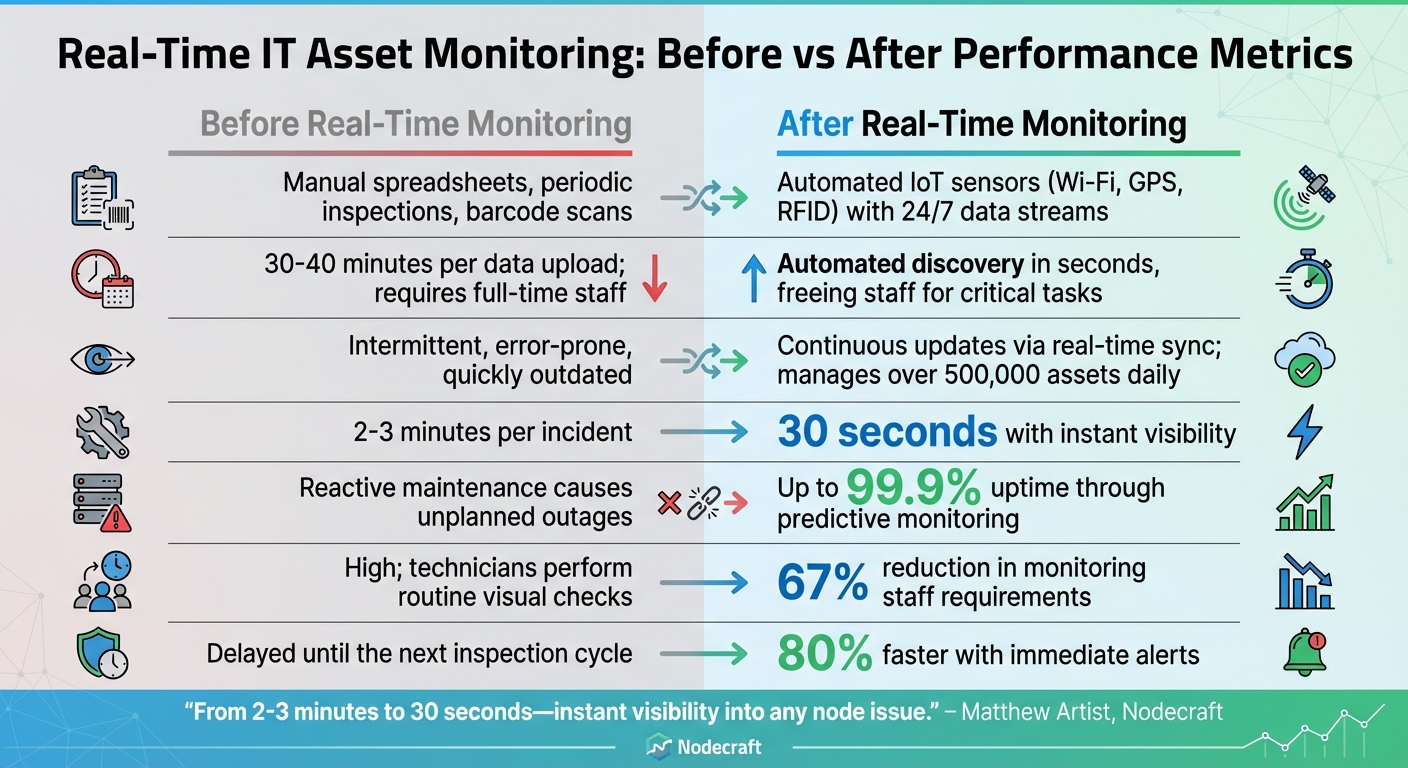
Real-Time IT Asset Monitoring: Before vs After Performance Metrics
Real-time monitoring transforms IT asset management across multiple metrics, delivering measurable improvements in efficiency, accuracy, and resource allocation.
| Metric | Before Real-Time Monitoring | After Real-Time Monitoring |
|---|---|---|
| Tracking Method | Manual spreadsheets, periodic inspections, barcode scans | Automated IoT sensors (Wi-Fi, GPS, RFID) with 24/7 data streams |
| Time Spent on Manual Tracking | 30-40 minutes per data upload; requires full-time staff | Automated discovery in seconds, freeing staff for critical tasks |
| Asset Visibility | Intermittent, error-prone, quickly outdated | Continuous updates via real-time sync; manages over 500,000 assets daily |
| Troubleshooting Time | 2-3 minutes per incident | 30 seconds with instant visibility |
| Downtime Reduction | Reactive maintenance causes unplanned outages | Up to 99.9% uptime through predictive monitoring |
| Staff Overhead | High; technicians perform routine visual checks | 67% reduction in monitoring staff requirements |
| Incident Resolution | Delayed until the next inspection cycle | 80% faster with immediate alerts |
For instance, Nodecraft reduced troubleshooting time from 2-3 minutes to just 30 seconds after adopting real-time monitoring. Similarly, Codyas cut monitoring staff by 67% while lowering operational costs by 46%. The Falkland Islands Government achieved a 99% reduction in website downtime, and LANCOM Systems reported 20% less downtime along with a 40% optimization in their budget.
"From 2-3 minutes to 30 seconds - instant visibility into any node issue."
– Matthew Artist, Nodecraft
These examples highlight the transformative impact of real-time monitoring. Companies like AssetRemix manage over 500,000 IT assets daily, leveraging real-time tracking to eliminate the tedious process of normalizing and deduplicating bulk CSV data imports. This allows IT teams to shift their focus from administrative work to strategic priorities. The data underscores how real-time monitoring drives operational efficiency and aligns with broader organizational goals.
Conclusion
Real-time IT asset monitoring is reshaping the way organizations handle their technology infrastructure. The key advantages - greater visibility and control, minimized downtime, cost reductions, simplified compliance, and data-driven decision-making - help create a more proactive and efficient IT environment. Instead of constantly reacting to problems, IT teams can anticipate and address them before they escalate.
These advantages lead to tangible operational improvements. Companies using real-time monitoring report faster issue resolution, better resource allocation, and improved system uptime. All of this not only saves money but also allows IT teams to focus on strategic priorities rather than routine maintenance.
With these proven benefits in mind, AdminRemix offers tools designed to elevate IT operations. AssetRemix delivers robust asset management through real-time synchronization, automated discovery, and integrated support features. The platform ensures security with 256-bit SSL encryption, Single Sign-On (SSO), and role-based access controls, protecting sensitive data while maintaining seamless operations.
"I signed up for Chromebook Getter because it's faster than getting what I need with GAM command lines." – Philip Helmers, SWBOCES LHRIC
AdminRemix also provides specialized tools like Chromebook Getter and User Getter, which bring real-time management to ChromeOS devices and G-Suite users through a simple Google Sheets interface. Starting a trial is hassle-free - no credit card required - so IT teams can quickly experience the operational improvements that real-time monitoring delivers. See the difference for yourself.
FAQs
What should we monitor in real time first?
To keep your IT operations running smoothly, start by keeping tabs on the status and location of all your IT assets in real time. This gives you greater visibility and control, reducing the chances of problems like equipment loss or misuse. Real-time monitoring acts as a cornerstone for effective IT management while helping to cut down on potential risks.
How can we start real-time monitoring without disrupting users?
To start real-time monitoring without causing interruptions, begin by cataloging all your assets and understanding their usage patterns. Use tools that can automatically discover and collect data from your network without interfering with its operations. These tools should integrate smoothly and work passively. Implement centralized, non-intrusive monitoring methods, like network-based tracking or RFID technology, to keep things efficient. Lastly, make sure to talk with your team, explaining how this will benefit them and reassuring them that their workflow won’t be disrupted.
How do we calculate ROI from real-time asset monitoring?
Real-time asset monitoring delivers measurable returns by cutting costs, boosting efficiency, and minimizing downtime. These improvements come from enhanced visibility and smarter management of assets. To get a clearer picture of its financial impact, tools like ROI calculators can be used to quantify these benefits, making the value of such systems easier to grasp.